Hobbes's Leviathan or How to Not Murder Each Other Over Politics
The Context, or Why Everyone Was So Upset
So it’s 1651 and Thomas Hobbes has just watched England tear itself apart for like a decade.The English Civil War (1642-1651) was basically what happens when you take the question “who should be in charge?” and answer it with “let’s find out with swords.” King Charles I thought God wanted him to run everything. Parliament thought, no, actually, we should have a say. The Puritans thought everyone else was doing Christianity wrong. The Catholics were nervous. The Scots were involved somehow. It was a mess.
Imagine if Twitter disputes could kill you. That was basically England in the 1640s.
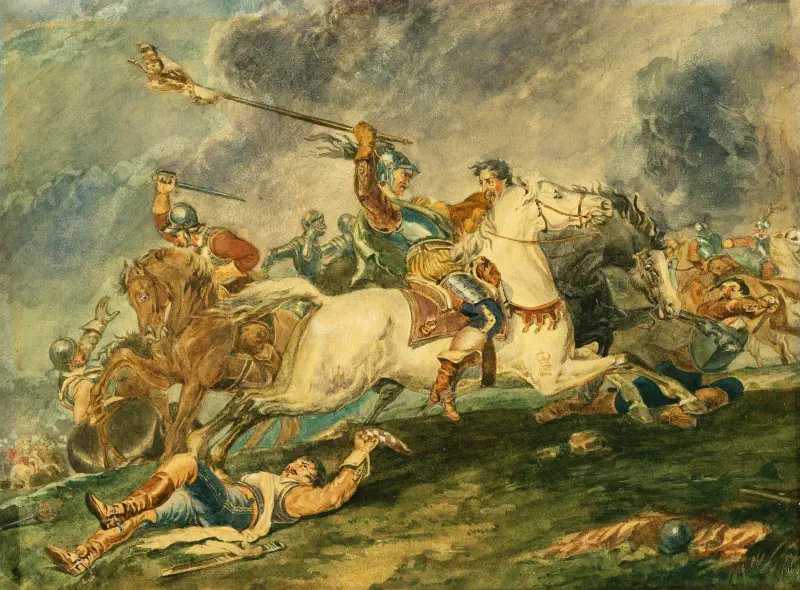
Hobbes, who was hanging out in Paris because England was too stabby, watched all this and thought: “You know what? This is what happens when you don’t have clear rules about who’s the boss.” So he wrote Leviathan, which is essentially a very long argument that goes: Look, humans are terrible, and without a really strong government, we’ll all murder each other over stupid stuff. So let’s agree to have an absolute sovereign, because even tyranny is better than civil war.
The State of Nature, or Why Your Neighbors Would Eat You
The core insight of Leviathan starts with what Hobbes calls the “state of nature .” This is his thought experiment about what life would be like without government. His conclusion? It would be “solitary, poor, nasty, brutish, and short.” Not “maybe occasionally unpleasant.” Not “somewhat suboptimal.” Nasty. Brutish. Short.
Here’s Hobbes’s logic, translated to modern terms:
- Everyone basically wants the same stuff (food, safety, Netflix passwords)
- There’s not enough stuff for everyone to have all they want
- We’re all roughly equal in our ability to hurt each other1
- Therefore, without rules, we’d constantly fight over everything
Think about Black Friday shopping, but for literally everything, all the time, and everyone has weapons.
The thing is, Hobbes argues, in this state of nature, you can’t even trust contracts. If I promise to trade you my cow for your chickens next week, what stops me from just keeping my cow and stealing your chickens? There’s no court system. There’s no police. There’s just you, me, and whoever has more friends with sharp objects.
The Social Contract, or The Deal Nobody Remembers Signing
So Hobbes proposes a solution: everyone should agree to give up their right to violence to one absolute sovereign. This is the “social contract ,” though importantly, Hobbes thinks this isn’t really a contract in the normal sense. It’s more like a mathematical proof of what rational people would do.
The logic goes:
- Life without government is terrible
- Any government is better than no government
- The strongest government is the best because it can actually keep the peace
- Therefore, we should have an absolute monarchy (or something similar)
It’s like if everyone in a bar fight simultaneously realized that bar fights are stupid and agreed that the bouncer should have absolute authority. Except the bouncer can also tax you, conscript you into the army, and censor your pamphlets. But hey, at least you’re not getting stabbed over theological disputes anymore!
The Sovereign, or Why Your King Can Do Whatever He Wants
Here’s where Hobbes gets controversial (well, more controversial). He argues the sovereign, whether it’s a king, parliament, or whatever should have basically unlimited power. The sovereign can’t commit injustice against the subjects because the sovereign defines what justice is. The sovereign is above the law because the sovereign makes the law.
Modern readers usually go: “Wait, what about checks and balances? What about human rights? What about constitutional limits?”
And Hobbes would say: “Did you see the English Civil War? That’s what your ‘checks and balances’ get you. A bunch of people checking and balancing each other with muskets.”
Why This Mattered Then (And Kind of Still Does)
The genius of Leviathan wasn’t that Hobbes was right about everything. He wasn’t.2 The genius was that he tried to build political philosophy from first principles, like a mathematical proof. Instead of saying “Kings should rule because God says so” or “Parliament should rule because of ancient English traditions,” he said, “Let’s think about what rational people would agree to.”
This was revolutionary. It made political authority a human creation, not a divine mandate. Even if you disagreed with Hobbes’s conclusions (and basically everyone did), you had to engage with his method.
Plus, Hobbes was writing when people were literally killing each other over political theory. His book was essentially saying: “Look, I’ve done the math, and the math says you should all stop stabbing each other and pick someone to be in charge. I don’t really care who, just pick someone and stick with it.”
The Reception, or How to Annoy Everyone Simultaneously
Leviathan managed to upset basically everyone:
- Royalists hated it because it said kings ruled by social contract, not divine right
- Parliamentarians hated it because it supported absolute sovereignty
- Religious authorities hated it because it subordinated church to state
- Pretty much everyone hated it because it was aggressively materialist and seemed kind of atheist-y
It’s like writing a book today that simultaneously argues for and against every political position, but with math.
The Legacy, or Why We Still Read This Thing
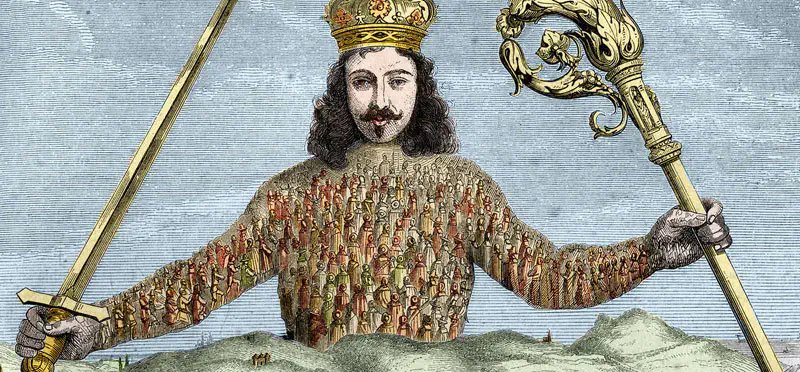
Here’s the thing: nobody really buys Hobbes’s whole program anymore. We don’t think absolute sovereignty is necessary. We’ve figured out ways to have functioning governments with checks and balances.3 We don’t even really buy his super pessimistic view of human nature.
But Hobbes gave us the tools to think about political authority without invoking God or tradition. He made us think about what we’re really agreeing to when we accept government authority. And his basic insight that the alternative to government might be really, really bad, still resonates when you look at failed states and civil wars.
Plus, his writing is weirdly compelling for a 17th-century philosophy text. The man could turn a phrase. “Nasty, brutish, and short” is honestly great copy.
Yes, some people are stronger than others, but Hobbes points out that even the weakest person can kill the strongest one while they’re sleeping. It’s oddly democratic, in a murdery sort of way. ↩︎
For instance, his theory of human psychology was basically that we’re all robots made of meat, which was a bit reductive even for the 1650s. ↩︎
Most of the time. Results may vary. Please consult your local constitutional crisis for details. ↩︎