Democracy in America
Democracy in America Is Weird
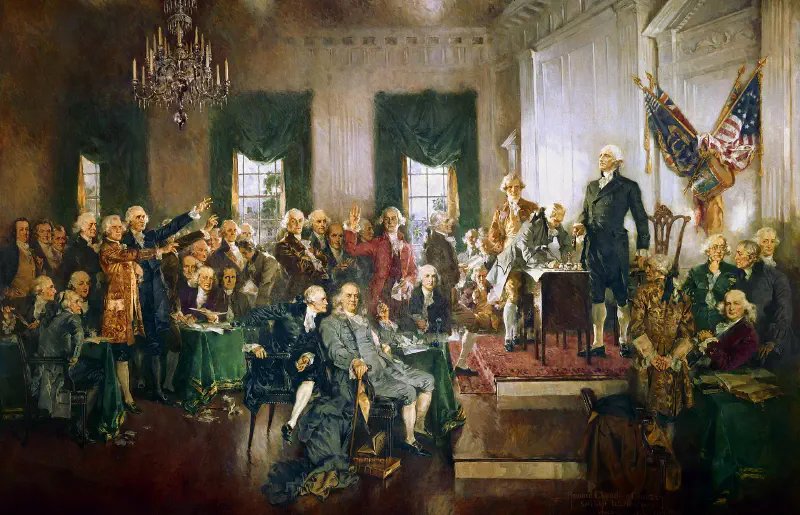
So there was this French guy, Alexis de Tocqueville, who showed up in America in 1831, supposedly to look at prisons but really to figure out what the deal was with democracy. And look, I know what you’re thinking: “Why do I care what some 19th-century French aristocrat thought about America?” But here’s the thing, the guy basically invented political science Twitter 200 years early.
Everyone’s Equal But Also Not
The main thing Tocqueville noticed was that Americans were obsessed with equality. Not like “everyone has the same stuff” equality Americans were definitely trying to get rich, but more like “nobody’s inherently better than anyone else” equality. No aristocrats! No inherited titles! Your dad could be a farmer and you could become president! (Or, more realistically, open a small business that fails, but still.)
This is weird! Most of human history is just, like, “some people are nobles and some people are peasants and that’s how it is.” Americans were like, “what if… not that?” Revolutionary, literally.
But here’s where it gets interesting. Tocqueville noticed that Americans loved equality more than freedom. Like if you said, “you can have freedom OR equality,” they’d pick equality. Which seems paradoxical? But actually makes sense when you think about it. I mean, what good is freedom if some duke can just show up and be like “actually I own you”?
The Genius of Doing Stuff Together
Okay so here’s my favorite Tocqueville observation. In France, if people wanted something done, they’d petition the king. In America, if people wanted something done, they’d just… form a committee. Need a library? Form a library association. Want to ban alcohol? Start a temperance society. Think your neighbor’s fence is too high? Obviously you need a Fence Height Regulation Society.
This sounds dumb but it’s actually genius? Like, instead of waiting for the government to solve problems, Americans just got together and solved them. It’s basically decentralized problem-solving. Very Web3, if you think about it. (I’m kidding. Sort of.)
The voluntary association thing is everywhere in American life. Churches, bowling leagues, PTAs, HOAs that tell you your mailbox is the wrong shade of beige, it’s all the same impulse. Tocqueville thought this was America’s superpower: you don’t need a strong government if everyone’s constantly forming little governments.
The Majority Can Be Terrifying, Actually
But here’s the dark side, and Tocqueville was really worried about this: what if the majority decides to be terrible?
In the old days, if the king was terrible, at least you knew who to blame. But in a democracy, if 51% of people decide something awful, that’s just… democracy working as intended? The majority isn’t just politically powerful; it’s socially powerful. If everyone thinks you’re wrong, you start to wonder if maybe you’re wrong. Social pressure is more effective than laws.
Think about it like this: in a monarchy, you can hate the king and everyone knows you hate the king and that’s fine, you’re just a dissenter. In a democracy, if you hate what everyone voted for, you’re weird. You’re antisocial. You’re not a team player. The peer pressure is intense.
American Contradictions Are Hilarious
Tocqueville kept noticing these bizarre contradictions:
- Americans are super individualistic (“I don’t need anyone!”) but also conformist (“Why is everyone looking at me weird?”)
- They hate aristocracy but desperately want to get rich
- They’re religious but also frantically materialistic
- They believe in equality but, uh, slavery exists
- They’re locally engaged but nationally? Total mess
It’s like America was speedrunning every possible political contradiction at once.
The Slavery Thing Is Going to Be a Problem
Speaking of contradictions! Tocqueville took one look at slavery and was like, “guys, this is going to end badly.” You can’t have a democracy based on equality while literally owning people. The math doesn’t math. He predicted this would cause, shall we say, some issues. (Spoiler alert: it did.)
Calling His Shots
The really wild thing is how much Tocqueville got right about the future:
Two Superpowers Thing: He said America and Russia would end up dominating the world. In 1835! Before Russia had even industrialized! Before America was even really a major power! That’s like predicting in 1995 that TikTok would be important.
Democratic Contagion: He said democracy would spread everywhere eventually. Not because it’s better (though he thought it might be), but because once people see equality is possible, you can’t put that genie back in the bottle.
Administrative State: He predicted democratic governments would get bigger and more centralized over time, even though Americans hated centralization. Why? Because equal citizens want equal treatment, and that requires standardization, and standardization requires bureaucracy. You want equal rights? Great, here’s your 500-page regulation on rights implementation.
The Ultimate Take
Here’s Tocqueville’s bottom line: Democracy is probably inevitable, but it’s not inevitably good. It’s like a tool that can build or destroy depending on how you use it.
For democracy to work, you need:
- People actually participating (not just tweeting about it)
- Strong local institutions (your boring town council matters!)
- Some kind of moral framework (religion, philosophy, whatever)
- Protection for minorities (the majority can be mean!)
- Balance between equality and freedom (you need both)
- Constant vigilance against becoming either anarchic OR despotic
The thing is, American democracy wasn’t perfect, it was deeply flawed, actually, but it was interesting. It was trying something new. And Tocqueville was like a management consultant showing up to study this weird startup called America and being like, “your business model makes no sense but somehow you’re growing 30% year-over-year?”
The meta-lesson is: democracy is weird, America is weirder, and somehow it kind of works? But also might not? But probably will? Unless it doesn’t?
Classic America, honestly.